Search Results
Fine Jewelry University Articles matching: “Loose gemstones”
Showing only FJU Article results. Click here to show all results.
Fine Jewelry University (Show All FJU Articles)
-

How to Tell If a Diamond Is Natural or Lab Grown
… IIa test is only an indicator for the gemologist to use. There are lab grown diamonds that are not Type IIa, and there are natural diamonds that are Type IIa, so it’s not a 100% conclusive test. Also, a diamond has to be completely loose (unmounted) to perform the test. Photoluminescence Spectroscopy and UV Radiation Going beyond the Type IIa test, more advanced equipment exists that uses spectroscopic techniques to analyze gems. One such machine is the DiaTrue …
-
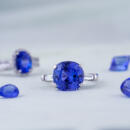
Gem in the Spotlight: Tanzanite
… that isn’t heated and is still pretty enough for jewelry displays trichroism. Trichroism is an effect that causes gemstones to display different colors when viewed at different angles. Tanzanite in its raw form has three colors: blue, purple… become extremely scarce in the future, further driving its desirability. Tanzanite is currently one of the rarest gemstones, and it is only found in one place on earth. In 2002 tanzanite was added as one of the birthstones for December …
-
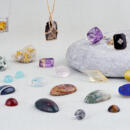
Gem in the Spotlight: Quartz
… at the title and knew). Quartz is one of the most common minerals on earth. Many quartz varieties are cut into gemstones, but some varieties are very rare. Some are ordinary like rock quartz, others are exotic like Drusy Quartz. Some quartz … create a dim light which is often called cold fire, as it creates enough light to see, but no heat. Famous Quartz Gemstones Quartz is one of the most abundant minerals in the earth’s crust, but there are still many noteworthy examples that …
-

Gem in the Spotlight: Topaz
Topaz is a gemstone with amazing variety. Topaz is naturally colorless and clear like a diamond, but it can also take on an entire range of colors. Yellow to reddish-orange is known as Precious Topaz or Imperial Topaz. Imperial Topaz is one of the expensive varieties of Topaz. Gem suppliers can even bombard Topaz in a nuclear reactor to produce various shades of Blue Topaz. Topaz is the birthstone for November, and they make great gifts for anyone born in November, or for anyone that just likes beautiful jewelry.
-
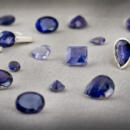
Gem in the Spotlight: Iolite
… that makes you a modern day Viking. The Gemology of Iolite Iolite is the gem variety of the mineral Cordierite. Iolite was once known as a “water sapphire”. Dichroite is another synonym for iolite. Dichroite is a Greek word which loosely translates as two-colored rock. This refers to iolite’s pleochroic nature. iolite cannot be heat treated to enhance its color. The color you see is the natural color of the stone when it was first discovered. Coming in at 7 to 7.5 on …
-
Synthetic Gems: The Whole Story
Synthetic rubies, emeralds, sapphires, diamonds and more are everywhere. Man made gems come in many forms: every thing from simple glass to high tech chemical tongue twister like gadolinium gallium garnet (also called GGG) and the modern diamond simulant moissanite. Synthetic gems are not bad, fakes, or the curse of a modern society. The more you know about them, the better you can understand their place in our society and in the jewelry world.
-
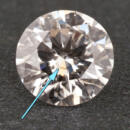
What Are Lab Grown Diamonds?
…is not, by nature, a fake (in fact it is a beautiful and highly valuable gem). But if it is being sold as a diamond, it becomes a fake. Most gem simulants are trying to imitate diamonds, but there are also simulants for other valuable gemstones (sapphires, rubies, etc.). Here are some of the more popular diamond simulants. Synthetic Rutile was introduced in the late 1940s and used as an early diamond simulant. Next on the man-made diamond simulant play is Strontium Titanate…
-
How Are Lab Grown Diamonds Made?
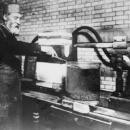
…, but none could ever be scientifically verified. The quest continued. Diamonds are a crystalline form of carbon, and so making artificial carbon crystal was the problem of lab grown diamonds. For decades, manufacturers of synthetic gemstones tried growing diamonds like they grew rubies, sapphires, and emeralds. It failed. Then they had the idea to grow diamonds in the lab like they grew in nature. High Pressure High Temperature Diamonds How does nature form diamond crystals…
-
Gem in the Spotlight: Sapphire
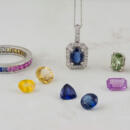
…, green, orange, and golden yellow are magnificent in any jewelry. See More on Etsy › With the exception of the diamond, which measures 10 on the Mohs scale, sapphire and ruby (9 on the Mohs scale) are the toughest and most durable gemstones. This toughness makes the sapphire a long lasting piece of jewelry as well as a useful industrial tool. One last legend, the star sapphire has been called “the stone of destiny”; its three crossed lines represented faith, hope, and …
