Search Results
Fine Jewelry University Articles matching: “Balance scale charm”
Showing only FJU Article results. Click here to show all results.
Fine Jewelry University (Show All FJU Articles)
-
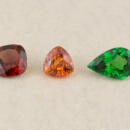
Gem in the Spotlight: Garnet
… are given as symbols of consistency, perseverance and good health. Some of the lore surrounding garnets is that it protects the wearer from nightmares, promotes long-lasting love, and prevents hearing difficulties. It was also a charm against the effects of anger and said to be a calming influence. Some promoted it as a cure for depression and mental instability. Garnets’ other cures are red garnet to relieve fever and yellow garnet was the prescription for jaundice. …
-
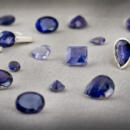
Gem in the Spotlight: Iolite
… or seeing two realms at the same time. Other lore and myths about iolite include its use to help in recovering balance by those suffering from disorientation, lack of motivation, chronic disorganization, and distraction. Iolite is said to … you see is the natural color of the stone when it was first discovered. Coming in at 7 to 7.5 on the Mohs hardness scale, iolite is a somewhat soft gem. It is comparable to quartz (Amethyst, Citrine, etc), a little harder than Opal, and …
-
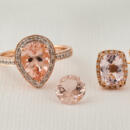
Gem in the Spotlight: Morganite
… of energy throughout the body due to its ability to bring pure love to the wearer. Morganite is also believed to balance emotions and bring harmonizing fulfillment as it releases any blocks to the channels of energy and love. It is even … properties of Morganite. Its durability is rated as excellent. Its hardness is 7.5 – 8.0 on the Mohs hardness scale which is comparable to emerald, topaz, and spinel. Its refractive index is 1.560 – 1.600, and its specific gravity is 2.67…
-

Art Deco vs. Art Nouveau Style Jewelry
… cuts. Design Principles Art Nouveau takes inspiration from nature and eschews rigid adherence to symmetry and balance. Organic Forms: Art Nouveau jewelry features sinuous, curving lines that mimic natural shapes such as vines, flowers, and …: Contrasting colors and materials create striking visual effects in Art Deco designs, emphasizing symmetry and balance. Innovation in Materials: Art Deco designers embraced new materials like Bakelite, celluloid, and chrome alongside …
-

Gem in the Spotlight: Topaz
… gemstone with a Mohs hardness of 8. Mohs hardness is a standardized metric of how difficult it is to scratch something. For reference, topaz is a bit softer than diamond which is a 10 and corundum (sapphire/ruby) which is a 9 on the scale. It is a bit harder than emerald at 7.5-8 and quartz which comes in at 7. Here are some more gemological stats for reference: Refractive index: 1.619 to 1.627 Birefringence: 0.008 to 0.010 Specific gravity: 3.53 Mohs Hardness: 8 Care …
-
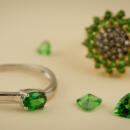
Gem in the Spotlight: Tsavorite Garnet
…. Gemology Tsavorite’s rarity and beautiful green color reminds one of the other green garnet called Demantoid. Demantoid, however, is a completely different variety of garnet found primarily in Russia. Tsavorite is 7.5 on the Mohs scale. It is a green grossular garnet with a chemical make-up of CA 3 Al 2 (SiO 4 ) 3 . It has a Refractive Index (RI) of 1.740 and a dispersion index of 0.028. So how did Tsavorite come to be called Tsavorite? Its technical description as a …
-
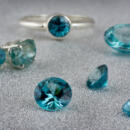
Gem in the Spotlight: Blue Zircon
… on, and today we use the simpler term, Blue Zircon. Zircon is commonly heat treated. Brown zircons can be transformed into colorless or blue zircons through heat treatments. Zircon is a durable gemstone with good hardness on the Mohs scale (6 to 7.5). However, Zircon has what is known as indistinct cleavage which creates a somewhat brittle tendency that can lead to chips, especially along facet edges requiring extra care when setting, cleaning, or wearing. The …
-
Gem in the Spotlight: Alexandrite
… out to over $70,000 per carat! Alexandrite is said to bring luck, prosperity, and intellect to its wearer. Its changing colors remind us that life has its ups and downs, and so alexandrite is also connected with bringing a sense of balance and well-being. Care and Cleaning of Alexandrite Alexandrite should always be treated with care because of its value and rarity. While ultrasonic and steam cleaners are usually safe for alexandrite, warm soapy water and a soft-bristled …
-
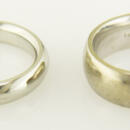
The Difference Between White Gold and Platinum
… careful choice of the alloying metals, which bleach the yellow of pure gold. Platinum is a naturally white metal. It does not need to be alloyed for color. Jewelry platinum is typically an alloy containing 90% to 95% platinum and the balance alloy. Iridium or ruthenium is often used as a hardener alloy. Platinum is usually marked with .900 or .950 to mark its fineness. Some manufacturers state what alloy they are using like 90% Platinum 10% Iridium. How white gold and …
