Search Results
Fine Jewelry University Articles matching: “Clear topaz”
Showing only FJU Article results. Click here to show all results.
Fine Jewelry University (Show All FJU Articles)
-
What to Do When Your Ring Irritates Your Skin
… coatings that can be added to jewelry to help alleviate reactions. They have mixed reviews, and, like plating, the coatings wear off over time. But, they can be enough to make jewelry wearable for some when plating alone fails. Clear nail polish is also very similar to these coatings, and you can definitely give that a try first if you have it on hand. Build up a few layers to insulate your skin from the metal. Sometimes, the only solution is to change to a ring made of…
-
Gem in the Spotlight: Opal
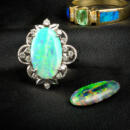
…of ironstone or black onyx and glue the fragile piece of opal to it before cutting and leaving them glued together after the fact to be set into jewelry. In triplets, that thin piece of opal is sandwiched between a piece of onyx and a clear piece of laboratory grown quartz (the same material that is commonly used for watch crystals). This helps show off the opal’s beauty while keeping it safe and strong. Doublets and triplets are much less expensive than other forms of …
-
How Are Lab Grown Diamonds Made?
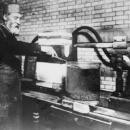
… this environment, the pure carbon melts and begins to form into a diamond around the starter seed. On December 16, 1954, a belt press was used to create the first reproducible lab grown diamond. The diamond was tiny and nowhere near clear enough to be used in jewelry, but it was a start. As a side note here, we should mention that even today most of the man-made diamonds that are produced are not of gem quality. They are made for industrial applications where the …
-

What are “Blood Diamonds”?
… to fund military action in opposition to those governments, or in contravention of the decisions of the Security Council.” These diamonds are sometimes referred to as “blood diamonds.” In July 2000, the global diamond industry made clear to the international community its zero tolerance policy towards conflict diamonds. Dedicated to eradicating the trade in conflict diamonds, it worked closely with the United Nations, governments and non-governmental organizations (NGOs…
-
Gem in the Spotlight: Iolite
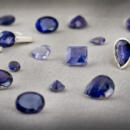
… called “The Viking Stone” as a polarizing filter to help them find the sun on cloudy days. They may have used a clearer, more transparent variety of the gemstone for this purpose. On a cloudy day, without being able to see the sun, iolite…soft gem. It is comparable to quartz (Amethyst, Citrine, etc), a little harder than Opal, and softer than Emerald or Topaz. Because of this, some extra care should be taken with your iolite jewelry. Try to avoid wearing it in situations …
-
Gem in the Spotlight: Peridot
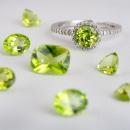
…it was believed that they intensified the effects of the drug. Gemologically speaking, Peridot is the gem variety of Olivine. It has a Moh’s hardness of 6.5 to 7 which makes it a little harder than Moonstone and a little softer than Topaz. Care should be taken to protect peridot from scratches, sharp blows, household chemicals and extreme temperature changes. Do not use a home ultrasonic machine for cleaning. Instead, use warm soapy water and a tooth brush for at-home …
-
Gem in the Spotlight: Tourmaline
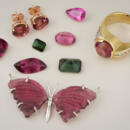
… not a species or member of a different family (unlike emerald and aquamarine, for example, which are members of the beryl family). It has a refractive index of 1.624 to 1.644 and a Mohs hardness of 7 to 7.5 which makes it softer than topaz or sapphire and harder than tanzanite or opal. Tourmaline is found in a huge variety of colors (sometimes even within the same gem), and some of these colors have their own names: Rubellite: is red, pinkish red, orangy red, or pink …
-
Gem in the Spotlight: Amethyst
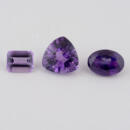
… deposits in other countries such as Russia, the United States, and Canada. Amethyst is known for its durability with a Mohs hardness rating of 7. For reference, amethyst is roughly as hard as tourmaline, softer than sapphire and topaz, and harder than opal and tanzanite. This makes it a durable gemstone that is resistant to scratching and chipping. It is also resistant to heat and chemicals which means that it can withstand daily wear and tear. Amethyst has the same …
-
Gem in the Spotlight: Morganite
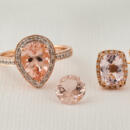
… gemstone for jewelry. For the gem nerds out there, here are a few of the gemological properties of Morganite. Its durability is rated as excellent. Its hardness is 7.5 – 8.0 on the Mohs hardness scale which is comparable to emerald, topaz, and spinel. Its refractive index is 1.560 – 1.600, and its specific gravity is 2.67 – 2.90. These characteristics help identify Morganite as beryl and distinguish it from other pink gemstones. Morganite is commonly heat treated to …
