Search Results
Fine Jewelry University Articles matching: “How much is a gram of gold”
Showing only FJU Article results. Click here to show all results.
Fine Jewelry University (Show All FJU Articles)
-
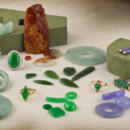
Gem in the Spotlight: Jade
… gem commonly available on earth. If you scraped them together, a diamond would scratch a piece of jade while the much softer jade wouldn’t leave a mark on the diamond. However, if you decided to smack both gems with a hammer (please don’…few laboratories produced synthetic (lab-created) jadeite. This proved to be unprofitable and was quickly forgotten; however, a small amount of it remains on the market and it is mostly undetectable Treatments and Sources of Jade Before …
-
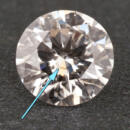
What Are Lab Grown Diamonds?
… the same chemical properties as a natural diamond, and we tend to avoid the term “synthetic diamond” given how much confusion it can create. There is another diamond simulant that creates a lot of confusion. Diamond coated Cubic Zirconia… “lab grown” over “synthetic.” In order to appreciate this fully, it helps to understand a little bit about how lab grown diamonds are made. There are two techniques to grow single crystal diamonds. The first and oldest is the High …
-

How to Tell If a Diamond Is Natural or Lab Grown
…, with lab grown diamonds, the chemical structure and properties are all the same as natural diamond, so it becomes much more difficult to differentiate them. Responsible Disclosure The first thing to realize is that most lab grown …How can I know if my diamond is real? This is a question we get all the time, and it’s not as simple as you might think… whether or not it is a Type IIa diamond. Type IIa is actually a gemological variant of the diamond that relates to how pure the carbon is that makes up the diamond. In nature, less than 2% of all diamonds are Type IIa, however, most gem…
-
Fake Diamonds: The Great Diamond Attack
…. Synthetic diamond crystal big and pretty enough for jewelry has been made since the 1950’s. But, it just costs too much to justify using them. The technology is becoming more cost effective, and some synthetic diamonds are entering the …A popular game show would have three people all say that they were someone and the contestant would try to find out who was the real … if the stone is of natural or manufactured origin. It can be done well with careful observation. Keep in mind, however, that the vast majority of lab grown or synthetic diamond producers responsibly disclose that their diamonds are man-…
-
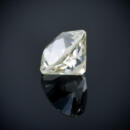
The History of Diamond Cuts
… and regional reasons. The unfortunate result of this in both the past and present is that it makes diamonds that much harder to understand. That’s why we at Arden Jewelers always strive to use standard, easy to understand names instead … irregular shape cut a crude Old Mine cut. Old Mine cut is the last cut where individual cutters took liberty with how the facets are laid out. Some look like a modern round brilliant (in layout, not in angles or shapes) and others …
-
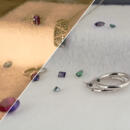
Gem in the Spotlight: Alexandrite
… fluorescent light has a stronger greenish-blue component, the stone appears greener. Under candlelight, which has a much stronger red/orange component, the stone will appear redder. Alexandrite has a refractive index of 1.746-1.755 with … LED light. Under incandescent light, candle, and firelight, alexandrite appears purplish-red. This is because of how the trace element chromium interacts with alexandrite’s crystal structure. It absorbs most wavelengths of light very …
-
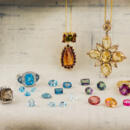
Gem in the Spotlight: Topaz
… one person say, “I love Topaz; it reminds me of a blue sky.” Then her friend says back, “Topaz may be like a golden sunset, but not the sky.” A third friend will chime in, “You’re both crazy, it’s like a beautiful peach.” Then, a …Some of these varieties have their own names: Imperial Topaz: When both orange and red colors are present (although much of the jewelry industry might call golden topaz imperial). Golden Topaz: Yellow to orange without any red component (…
-
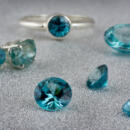
Gem in the Spotlight: Blue Zircon
… color. But, zircon can be almost any color you can imagine including red, yellow, orange, brown, green, champagne, golden, saffron, and colorless. Zircon colors are pure and have that distinctive fire that sets it apart from other gems. … a rainbow. Then the rainbow effect is broken and focused by the facets of the gem to create the brilliant light show we see. Zircon is also of interest to geologists because it is one of the oldest minerals on earth. In the gem world, a…
-
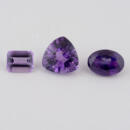
Gem in the Spotlight: Amethyst
…used in jewelry. Purple has long been considered a royal color, so it is not surprising that amethyst has been in so much demand throughout history. Gemology Amethyst is a variety of quartz that is colored by the presence iron and …The violet color of amethyst can range from a pale lavender to a deep, dark purple, and it is often found in shades of pale to medium purple. Amethyst is typically found in Brazil, Uruguay, and Madagascar, but it can also be found in …
