Search Results
Fine Jewelry University Articles matching: “Precious stone”
Showing only FJU Article results. Click here to show all results.
Fine Jewelry University (Show All FJU Articles)
-
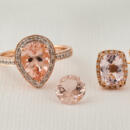
Gem in the Spotlight: Morganite
Morganite is a beautiful, soft pink gemstone and a graceful expression of elegance. It is not a very well-known gem, but it definitely should be. It is pastel or…. It is the subtle, understated nature of Morganite’s color that sets it apart from many of the more popular gemstones. Morganite has an impressive family tree. It is a beryl gem which puts it in the same family as emerald and aquamarine. …pink variety of beryl “Morganite”. It has good hardness, durability, luster, and brilliance which make it a great gemstone for jewelry. For the gem nerds out there, here are a few of the gemological properties of Morganite. Its durability …
-
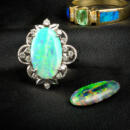
Gem in the Spotlight: Opal
… the gem world, and the lore that surrounds it is almost as colorful as the gem itself. Opal is the traditional birthstone for those lucky enough to born in October, and it is found in a huge variety of colors (sometimes all within the … color, and a wide range of colors. Red carries more value and is by far the rarest color that opals can display. Stones with larger patches of color are valued higher than those that display only small pins (pinfire) or no play of color …
-
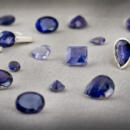
Gem in the Spotlight: Iolite
Iolite is maybe not the first gemstone people think of for their blue-violet jewelry, but it should be near the top of the list. Iolite’s color range of … popular gems, iolite cannot be heat treated to enhance its color. The color you see is the natural color of the stone when it was first discovered. This adds value to many gem buyers who don’t want a treated gemstone. Color Me Impressed … is caused by differing absorption of light rays in doubly refractive crystals. Thus, no singly refractive gemstone can exhibit pleochroism. The process works because of the ability of a gem to absorb different wavelengths of transmitted …
-
Frequently Asked Question about Jewelry
… the Diamond does not chip or is not otherwise altered. An appraisal can be performed on a loose Diamond, a mounted stone, or jewelry. If the stone is not loose, the physical properties are estimated using various estimation techniques. …. Carat is the weight of a gem. A carat equals 1/5 of one gram. Cut has two components to it. The shape of the stone and the way facets are positioned on the diamond. Color is actually looking for the absence of color or transparency. …
-
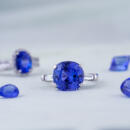
Gem in the Spotlight: Tanzanite
Beauty and rarity are two wonderful traits in a gemstone. Tanzanite has them both. In fact, it is estimated that Tanzanite is 1,000 times rarer than diamond. But, what makes… majority (current estimates are around 95%) of tanzanite is heat treated to help bring out the vibrant blues. The stones that haven’t been heated by humans were heated through natural effects while they were still underground. Without … isn’t heated and is still pretty enough for jewelry displays trichroism. Trichroism is an effect that causes gemstones to display different colors when viewed at different angles. Tanzanite in its raw form has three colors: blue, purple, …
-
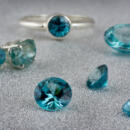
Gem in the Spotlight: Blue Zircon
Zircon may be last in the alphabet of gemstones, but it is first in sparkle. The crystal structure of zircon creates one of the liveliest displays found in any … other colored gems? Zircon has a high refractive index (1.92-2.01). The refractive index (abbreviated RI) of a gemstone is its optical property that refers to the ratio of the speed of light in a vacuum to the speed of light through a … is also of interest to geologists because it is one of the oldest minerals on earth. In the gem world, a type of stone is often given different names for each of its colors, and Zircon is no exception. Here are examples of a few of them. …
-
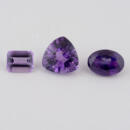
Gem in the Spotlight: Amethyst
… hard as tourmaline, softer than sapphire and topaz, and harder than opal and tanzanite. This makes it a durable gemstone that is resistant to scratching and chipping. It is also resistant to heat and chemicals which means that it can …tears of wine in remorse for his actions. These tears stained the quartz purple, resulting in the creation of the gemstone known as amethyst. Amethyst has a long history of being used in jewelry and other decorative items. It was highly …
-
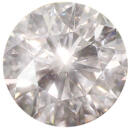
Diamond Buying Guide: The 4 C’s
…in comparison to each other. Cut The Cut of a diamond has two main components. First, cut refers to the shape of the stone. Round, marquise, pear, oval, square, princess all describe the shape of the diamond. Checkout the picture above to …diamond is cut to quality proportions (regardless of its shape) the maximum light is returned through the top of the stone giving a great light show. Cuts that are too shallow or too deep allow light to escape resulting in loss of …
-

How to Tell If a Diamond Is Natural or Lab Grown
… have imaginative names like DiamondCheck, DiamondSure, and DiamondView. Roughly speaking, these machines work like our DiaTrue. They bombard a diamond with specific types of radiation (nothing harmful to humans) and analyze what the stone outputs. There are certain, tell-tale signs of the various processes used to make lab grown diamonds that show up as spikes and troughs at specific wavelengths in the spectroscopic analysis. With CVD diamonds, the DiamondView machine …
