Search Results
Fine Jewelry University Articles matching: “Natural golden sapphire”
Showing only FJU Article results. Click here to show all results.
Fine Jewelry University (Show All FJU Articles)
-
Fake Diamonds: The Great Diamond Attack
… lookalikes. “What is a real diamond?” is a difficult question these days. And the problem of separating a fully natural diamond from all the modern possibilities is quite demanding. So what is a real diamond? Let’s start with the older … but is man made. So, a synthetic diamond is the same chemistry (carbon element) and crystal structure (cubic) as natural diamond but made in a factory. Yes, they can make synthetic diamonds and have for many years now. Most are used in the …
-
Synthetic Gems: The Whole Story
Ruby, sapphire, emerald and alexandrite are very beautiful gems and very rare in their stunning beauty. These four gems have been … thousands of years. But, what if anyone could own them? At gem shows and museums, I have seen jaw dropping rubies, sapphires and emeralds. These gems in high quality have put ownership beyond most people to justify the price. Just a one …to positively identify as synthetic. Both, I feel, are impossible to identify in a piece of jewelry. Synthetic ruby, sapphire, alexandrite and emerald are very complex because there are different ways to make them. The inexpensive way to make…
-
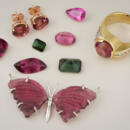
Gem in the Spotlight: Tourmaline
… is one of the most beautiful gems that you’ve probably never heard of. Less popular than the likes of ruby or sapphire, tourmaline flies under the radar in the gem world and remains the best kept secret of gem collectors and connoisseurs who… it for hundreds of years. But, before the advent of modern gemology, most tourmaline was believed to be ruby, sapphire, or emerald. Gemology of Tourmaline Gemologically speaking, tourmaline is its own mineral and not a species or member of a…
-
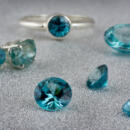
Gem in the Spotlight: Blue Zircon
… the manmade diamond simulates were made, the colorless version of zircon was used in jewelry to mimic diamond. Why? Natural zircon is known for its scintillation, brilliance, and flashes of color or fire just like diamond. Zircon also is … name for colorless Zircon. Starlite is the name for the blue gem variety of Zircon. The color of Starlite is rarely natural, and is almost always heat treated. Of course, the blue form of Zircon is also called, imaginatively, Blue Zircon. …
-
Gem in the Spotlight: Alexandrite
Emerald by day, ruby by night, more expensive than diamond and more illustrious than sapphire, emerald, or even ruby, alexandrite has been known around the world as one of the most sought-after gems for the … isn’t the only stone to display color-change phenomena. There are color-change varieties of many gems including sapphire, tourmaline, spinel, garnet, etc. Alexandrite is, however, the most famous for it. It is so famous, in fact, that color-… of 8.5. Because of its high hardness, alexandrite is suitable for everyday wear. That being said, because of natural alexandrite’s tremendous value and rarity, it is recommended to be worn carefully or put in jewelry such as earrings or …
-
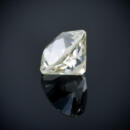
The History of Diamond Cuts
… to change their shape. So, the Romans wore uncut diamonds. One of diamond’s remarkable attributes is that the natural diamond crystal is beautiful without any human modification. Diamonds normally form in the octahedral shape which looks … like two pyramids stuck together at the base. Naturally, the first attempts to enhance diamonds were to polish the natural gem. The “point cut” is the polishing of a natural octahedral diamond. Interesting fact #1 about diamond cuts: …
-
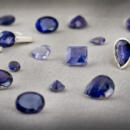
Gem in the Spotlight: Iolite
…near the top of the list. Iolite’s color range of blue, blue-violet, and violet competes for public attention with sapphire, tanzanite, and amethyst. They may have name recognition, but iolite has a rich, unique color and great gem value on …. The Gemology of Iolite Iolite is the gem variety of the mineral Cordierite. Iolite was once known as a “water sapphire”. Dichroite is another synonym for iolite. Dichroite is a Greek word which loosely translates as two-colored rock. This …
-
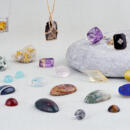
Gem in the Spotlight: Quartz
… is known for its durability with a Mohs hardness rating of 7 (harder than opal and peridot but softer than topaz or sapphire). This makes it a fairly hard gemstone that is resistant to scratching and chipping. It is also resistant to heat … and sometimes unattainably expensive? If you answered quartz to all these questions you would be right (but naturally you looked at the title and knew). Quartz is one of the most common minerals on earth. Many quartz varieties are cut into …
-

How Are Lab Grown Diamonds Made?
… lab grown diamonds. For decades, manufacturers of synthetic gemstones tried growing diamonds like they grew rubies, sapphires, and emeralds. It failed. Then they had the idea to grow diamonds in the lab like they grew in nature. High … Temperature Diamonds How does nature form diamond crystals? Nature does it very deep underground. Diamond growing naturally takes place about 100 miles below the earth’s surface. Why? Because that is where the conditions of extremely high …
