Search Results
Fine Jewelry University Articles matching: “blue star sapphire”
Showing only FJU Article results. Click here to show all results.
Fine Jewelry University (Show All FJU Articles)
-
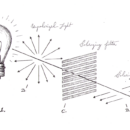
The Magic of Polarized Light
… (DR) and they will split incoming light in multiple directions. Some common examples of doubly refractive gems are sapphire, tourmaline, and moissanite. These are contrasted with singly refractive (SR) gems like diamond that only bend light … see through the surface of water or only capture the reflection. Modern 3D movies: Unlike old school red and blue 3D movies, modern 3D uses two images along with a pair of glasses that have polarizing filters for lenses. This tricks your…
-
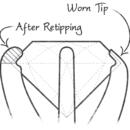
Jewelry Repair FAQ
… way it did before a gemstone fell out; who wouldn’t? That’s why we have literally 100s of carats of loose diamonds, sapphires, rubies, opals, pearls, and more in all shapes and sizes to choose from when selecting a replacement stone for …by the jeweler’s torch. However, with our laser welder we are able to retip prongs next to many gemstones (diamonds, sapphires, and rubies for example) without removing them, saving you time and money. Can my costume and fashion jewelry be …
-
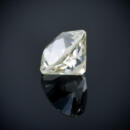
The History of Diamond Cuts
…culet (the point at the bottom of the diamond). Diamonds have gone from one facet (the table) to 18 facets. This cut started to unlock the brilliance within the diamond, and variations of it are still used today. Another early diamond cut… are four triangle facets that point towards the corners of the crown. This gives the appearance of a four-pointed star. The pavilion is cut into four main facets. Moving Towards Brilliance The evolution of the diamond cuts then takes a …
-
Gem in the Spotlight: Quartz
… Bloodstone Green jasper dotted with bright red spots Carnelian Reddish orange chalcedony Gemology of Quartz Quartz is known for its durability with a Mohs hardness rating of 7 (harder than opal and peridot but softer than topaz or sapphire). This makes it a fairly hard gemstone that is resistant to scratching and chipping. It is also resistant to heat and chemicals, which means that it can withstand daily wear and tear very well. All quartz has the same refractive index at…
-
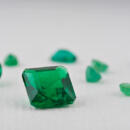
Gem in the Spotlight: Emerald
… and aquamarine) and are valued for their rich green color. The intensity of an emerald’s hue depends on the presence of chromium and vanadium in the crystal structure. Emerald’s Mohs hardness rating is 7.5-8 making it softer than sapphire and harder than amethyst and other quartz varieties. The refractive index of emerald ranges from 1.57 to 1.58, making it a moderately refractive gemstone. Its specific gravity ranges from 2.65 to 2.75. One of the distinctive features of …
-
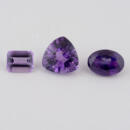
Gem in the Spotlight: Amethyst
… found in smaller deposits in other countries such as Russia, the United States, and Canada. Amethyst is known for its durability with a Mohs hardness rating of 7. For reference, amethyst is roughly as hard as tourmaline, softer than sapphire and topaz, and harder than opal and tanzanite. This makes it a durable gemstone that is resistant to scratching and chipping. It is also resistant to heat and chemicals which means that it can withstand daily wear and tear. Amethyst …
-
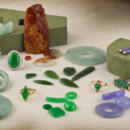
Gem in the Spotlight: Jade
…polish. Nephrite is commonly found in a darker olive green color but can also be very light green, orangey-red, black, and yellowish green. Jadeite can come in many different colors including pink, purple (often called lavender jade), blue, black, white, and the most valuable/desirable color: a vibrant green. The finest of all green jadeite colors is a saturated emerald green that is almost transparent, and it is called “Imperial Jade.” Jade is one of the top selling …
-
How Are Lab Grown Diamonds Made?
… lab grown diamonds. For decades, manufacturers of synthetic gemstones tried growing diamonds like they grew rubies, sapphires, and emeralds. It failed. Then they had the idea to grow diamonds in the lab like they grew in nature. High … is to create an environment of extremely high pressure and temperature where diamond growth can occur. Each process starts with a small diamond seed which is placed in carbon and put under very high pressure and temperature to grow the …
-
Gem in the Spotlight: Pearl
…French Polynesia. They are known for their dark, rich colors, which range from dark green and gray to deep shades of blue and black. Tahitian pearls are generally large with an average size of 9mm to 18mm, and they commonly have baroque …, loosen, and discolor over time. We recommend that you have your strand checked once a year. If the silk thread is starting to wear out, it’s best to have them restrung before it breaks. Pearl Vocabulary There is a lot to know when you …
